Z Image vs Nano Banana Pro: Which AI Image Generator Is Right for You?
Last Updated: 2026-01-22 18:08:28
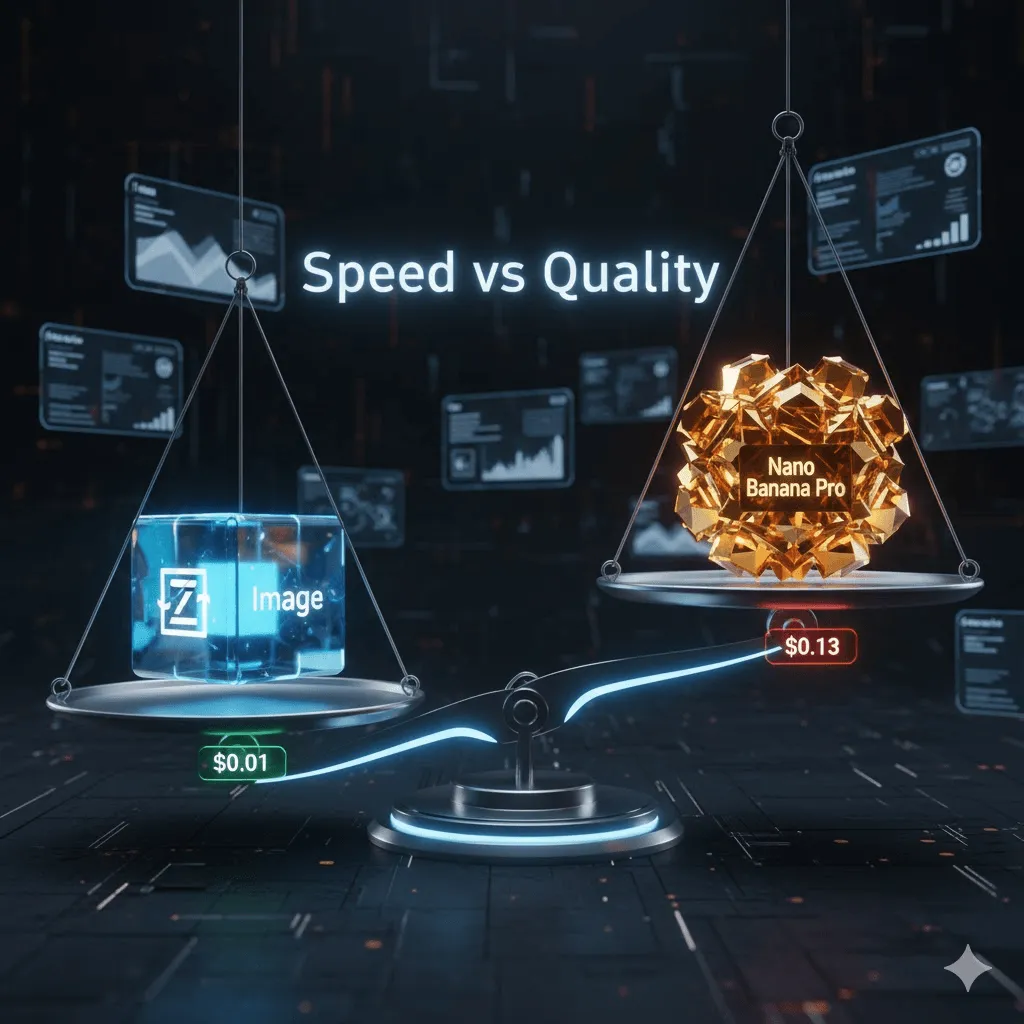
After spending weeks testing both Z Image and Nano Banana Pro across real production workflows, I've discovered that choosing between them isn't about finding the "best" model it's about matching capabilities to your actual needs. One costs 27x more than the other, yet neither is universally superior.
This guide breaks down what I've learned through hands on testing, including where each model excels, where it falls short, and how to decide which fits your workflow.
Quick Comparison Table
| Feature | Z Image Turbo | Nano Banana Pro |
| Speed | 1 3 seconds | 5 10 seconds |
| Cost (1K image) | $0.01 | $0.134 (official) / $0.05 (3rd party) |
| Parameters | 6B | Undisclosed (Gemini 3 Pro) |
| Resolution | Up to 2K native | 1K, 2K, 4K native |
| Text Rendering | Basic (English), struggles with Chinese | Excellent (50+ languages) |
| Deployment | Self host or API | Cloud API only |
| License | Apache 2.0 (open source) | Proprietary |
| Best For | High volume, speed critical | Quality critical, text heavy |
TL;DR: When to Use Each
Use Z Image when:
- You're generating hundreds or thousands of images
- Speed matters more than perfection
- Budget is tight
- You want to self host
- Text in images isn't critical
Use Nano Banana Pro when:
- You need accurate text in images (posters, infographics)
- Quality justifies the premium cost
- You're creating client facing assets
- Semantic accuracy matters (historical scenes, complex concepts)
- You need multi turn editing without regenerating
The Core Difference
Z Image and Nano Banana Pro solve different problems.
Z Image is Alibaba's answer to a simple question: "Can we make a small, fast model that's good enough for 80% of use cases?" The answer turned out to be yes. At 6 billion parameters and 8 inference steps, it generates photorealistic images faster than you can refresh a webpage.
Nano Banana Pro (Google's Gemini 3 Pro Image) asks a different question: "What if we apply language model reasoning to image generation?" Instead of treating prompts as keyword soup, it actually understands what you're asking for. The result? Images that make semantic sense, with correctly rendered text and logical composition.
The tradeoff? Nano Banana costs 27x more at official pricing.
Speed: Not Even Close
In my testing on an RTX 4090, Z Image consistently generated 1024×1024 images in 2.1~2.8 seconds. Nano Banana Pro (via API) took 5~8 seconds for the same resolution.
That might not sound like much, but it compounds. Generating 100 concept variations:
- Z Image: ~4 minutes
- Nano Banana Pro: ~10 minutes
For a 1,000 image e commerce catalog update:
- Z Image: 35~50 minutes
- Nano Banana Pro: 80~160 minutes
There's a caveat though Nano Banana Pro's batch API offers 50% cost savings if you can wait up to 24 hours. For non urgent bulk work, this changes the math significantly.
Cost Breakdown: The Real Differentiator
Here's where things get interesting. Let me break down actual monthly costs for different scenarios:
Scenario 1: Social Media Creator (100 images/month)
- Z Image: $0.50
- Nano Banana Pro: $13.40 (official) or $5.00 (third party)
Verdict: Z Image wins unless you need text rendering.
Scenario 2: E Commerce Store (2,000 product shots/month)
- Z Image: $10
- Nano Banana Pro: $268 (official) or $100 (third party)
Verdict: Z Image is the only economically viable option.
Scenario 3: Marketing Agency (5,000 images/month)
- Z Image: $25
- Nano Banana Pro: $670 (official) or $250 (third party)
Verdict: Depends on client requirements and billable rates.
The pattern is clear: Z Image makes sense at scale. Nano Banana Pro works when individual image quality matters more than quantity.
One more thing Z Image is Apache 2.0 licensed. If you have the technical chops and GPU hardware, you can self host and pay nothing per image (beyond electricity and depreciation).
Image Quality: Different, Not Better or Worse
After generating several hundred test images with identical prompts, here's what I've noticed:
Z Image's aesthetic: Natural, slightly imperfect, film like. Think Kodak Portra 400 shot at golden hour. There's grain, subtle color shifts, and that lived in quality that makes images feel authentic rather than generated. Sometimes this is exactly what you want editorial photography, lifestyle content, anything that needs to feel "real."
Nano Banana Pro's aesthetic: Clinical precision. Perfect lighting, sharp edges, balanced composition. It's what you'd get from a $20K medium format camera with professional retouching. Great for product photography and advertising where polish is paramount.
Neither is objectively better. I've used Z Image for client work that needed authentic editorial vibes, and Nano Banana Pro for campaigns requiring pixel perfect commercial quality.
Text Rendering: Nano Banana Wins (By a Lot)
This is where the gap becomes non negotiable for certain use cases.
Z Image's text handling: Fine for short English phrases. Struggles with longer text blocks. Absolutely fails at Chinese characters it hallucinates plausible looking but completely wrong glyphs. Decorative text works for mockups but shouldn't be trusted for production.
Nano Banana Pro's text handling: Industry leading. Accurate multilingual rendering across 50+ languages. Handles complex typography, lengthy paragraphs, and maintains semantic correctness. If your workflow involves posters, infographics, product packaging, or anything with critical text, this capability alone might justify the cost premium.
Real example: I tried generating a bilingual (English/Chinese) event poster with both models. Z Image got the English mostly right but invented Chinese characters that looked authentic but meant nothing. Nano Banana Pro nailed both languages perfectly.
Hardware and Deployment
Z Image:
- Runs on 16GB VRAM (RTX 4090, 4080, even 3080)
- Quantized fp8 version fits in ~6GB
- Can run on Intel Arc GPUs (slower, but possible)
- Self hosting eliminates per image costs
- ComfyUI, Automatic1111, diffusers support
Nano Banana Pro:
- Cloud API only (no self hosting)
- Requires Google account and API key
- No hardware requirements (processed on Google's infrastructure)
- Integrates with Google Workspace
The difference matters. If you have GPU hardware and technical expertise, Z Image's self hosting option is compelling. If you prefer managed services and don't want to deal with infrastructure, Nano Banana Pro's cloud only model is simpler.
Real World Use Cases
Let me share where I've actually used each model in production:
Social Media Content (Z Image)
Client needed 200+ Instagram posts over three months. Budget was tight, speed mattered, and the natural aesthetic fit their brand. Z Image was perfect. Cost: $1 total. Time: ~10 minutes per batch of 20 images.
Product Launch Campaign (Nano Banana Pro)
Different client, premium positioning, needed posters with headlines in English and Spanish. Text accuracy was non negotiable. Despite the higher cost ($67 for 100 variations), Nano Banana Pro eliminated the need for manual text correction.
E Commerce Catalog (Z Image)
Startup needed lifestyle shots for 500 products. Couldn't afford $67 (or even $25 at third party pricing) for 500 images. Z Image at $2.50 made it possible. Quality was good enough for web display.
Editorial Magazine (Hybrid Approach)
This is where it got interesting. I used Z Image to explore 50+ concept directions quickly, then regenerated the top 10 with Nano Banana Pro for final publication quality. Best of both worlds: Z Image for exploration ($0.25), Nano Banana Pro for finals ($6.70 with third party pricing).
Limitations Worth Knowing
Z Image stumbles on:
- Long or complex text (especially non English)
- Very abstract, conceptual prompts
- Maintaining character consistency across multiple images
- Sophisticated compositional storytelling
I learned this the hard way trying to generate a surreal advertising concept. The model gave me competent but uninspired results stacked products with generic compositions. It works best when you're specific about technical details: camera angle, lighting, style references.
Nano Banana Pro struggles with:
- Cost at scale (obviously)
- Speed for real time applications
- Sometimes over beautifies images, losing authentic imperfections
- Can't be customized beyond prompt engineering
Also worth noting: Nano Banana Pro occasionally interprets rather than executes. It might "improve" your concept based on what it thinks you want, which isn't always helpful when you have a specific vision.
The Hybrid Workflow
Here's what actually works in practice:
- Rapid exploration with Z Image → Generate 20~50 variations in minutes ($0.10~0.25)
- Review and select → Pick top 3~5 directions
- Refine with Nano Banana Pro → Regenerate winners with higher quality ($0.20~0.67)
- Text integration → Use Nano Banana Pro for any text heavy assets
- Bulk derivatives → Use Z Image for high volume variations
This approach costs ~$1~2 per project instead of $20~50, while maintaining quality where it matters.
Prompt Engineering Differences
Z Image responds well to: "Professional headshot, 30 year old man in charcoal suit, Canon EOS R5, 85mm f/1.8, shallow depth of field, soft studio lighting from left, modern office background, 8K resolution"
Camera specs, technical language, specific equipment references help. Think like a photographer.
Nano Banana Pro works better with: "Create a magazine cover capturing Wong Kar wai's aesthetic confident woman with umbrella on rain slicked Hong Kong streets, moody lighting with neon reflections, cinematic contrast"
Natural language, conceptual direction, cultural references. Think like a creative director.
Both approaches work for both models, but leaning into their strengths yields better results.
Cost Calculator
Let's make this concrete. How much would YOUR workflow cost?
Monthly image volume × per image cost = monthly spend
| Monthly Volume | Z Image Cost | Nano Banana (Official) | Nano Banana (3rd Party) |
| 50 | $0.25 | $6.70 | $2.50 |
| 100 | $0.50 | $13.40 | $5.00 |
| 500 | $2.50 | $67.00 | $25.00 |
| 1,000 | $5.00 | $134.00 | $50.00 |
| 5,000 | $25.00 | $670.00 | $250.00 |
| 10,000 | $50.00 | $1,340.00 | $500.00 |
Factor in your hourly rate and time saved. If Nano Banana Pro saves you 2 hours of manual text correction per month at a $50/hr rate, the extra $100/month pays for itself.
Technical Specifications
Z Image Architecture
- Model: Scalable Single Stream Diffusion Transformer (S3 DiT)
- Parameters: 6 billion
- Inference Steps: 8 (configurable 1~8)
- Text Encoder: Qwen3~4B
- VRAM: 16GB minimum (6GB with quantization)
- Distillation Method: Decoupled DMD (Distribution Matching Distillation)
- License: Apache 2.0
- Ranking: 8th overall, #1 open source (Artificial Analysis Leaderboard)
Nano Banana Pro Architecture
- Model: Gemini 3 Pro Image (multimodal foundation)
- Parameters: Undisclosed
- Context Window: 64K input, 32K output
- Resolution: 1K, 2K, 4K native support
- Knowledge Integration: Real time Google Search connectivity
- Text Rendering: 50+ languages with industry leading accuracy
- Deployment: Cloud API only (Google infrastructure)
Frequently Asked Questions
Can I use Z Image for commercial projects? Yes, Apache 2.0 license allows commercial use without restrictions.
Which is better for beginners? Nano Banana Pro (via Gemini app) has a simpler interface. Z Image requires some technical setup unless using API providers.
Can I combine them in one workflow? Absolutely. Many users (including me) use Z Image for exploration and Nano Banana Pro for finals.
Does Z Image work on Mac M1/M2? Not natively. You'll need to use API providers like fal.ai instead of self hosting.
Can Nano Banana Pro generate NSFW content? No, it has built in safety filters. Z Image is less restrictive.
Which handles anime/illustration styles better? Z Image adapts better to non photorealistic styles through community fine tunes. Nano Banana Pro leans toward realism.
What About Other Models?
FLUX.2 Pro ($0.03/image) sits between these two in pricing and capability. It offers higher detail than Z Image with better text rendering than both, but slower than Z Image and pricier than necessary for most workflows. Worth considering if you need the middle ground.
Midjourney (subscription based) and DALL E 3 ($0.04~0.08/image) are also solid choices, each with distinct aesthetics and pricing models. The comparison above holds: evaluate cost, speed, and quality against your specific needs.
My Recommendation
Start with Z Image if:
- You're exploring what AI image generation can do
- Budget is tight
- You generate high volumes
- Speed matters
- You have GPU hardware
Try Nano Banana Pro if:
- Text accuracy is critical
- You need that extra quality polish
- Per image cost doesn't matter
- You prefer managed cloud services
- Semantic accuracy matters for your niche
Or do what I do: use both strategically. Z Image for exploration and volume, Nano Banana Pro for finals and text critical work.
Where to Try Them
Z Image:
- API: fal.ai, Replicate, WaveSpeedAI
- Self host: Hugging Face (Tongyi MAI/Z Image Turbo)
- Interface: ComfyUI, Higgsfield
Nano Banana Pro:
- Google Gemini app (free tier: 3 images/day)
- Google AI Studio (API access)
- Third party: Kie.ai, GlobalGPT
Both offer free trials or tier. Test with your actual use cases before committing.
Final Thoughts
The "best" model doesn't exist. Z Image excels at speed and cost efficiency. Nano Banana Pro wins on quality and text rendering. Your choice depends entirely on what matters for your workflow.
I use both. Most weeks, 90% of my generation happens on Z Image. But that 10% where I need perfect text or that extra polish? Nano Banana Pro every time.
The real insight isn't Z Image vs Nano Banana Pro it's understanding that AI image generation has matured beyond the "one model to rule them all" phase. Different tools for different jobs, just like photography equipment.
Start with whichever solves your immediate problem. Adjust as you learn what you actually need versus what you thought you needed.
That's the real comparison.